
I’ve been living inside stories for as long as I can remember.
Where It Began
A Life Shaped by Books
I started reading early, in a home where books mattered—growing up on a farm in the Midwest, where quiet moments were filled with pages rather than screens. My mother always had a book nearby, and as I got older, we shared them—passing stories back and forth like a conversation.
My father was responsible for one of my earliest literary obsessions when he handed me the first books in The Black Stallion series. By high school, I was working in the library, reading well beyond my age, helping other people find their next great book, and spending as much time among the shelves as I possibly could.
Apparently, I was always going to end up working with stories.
“A reader lives a thousand lives before he dies.”
- George R. R. Martin
Making Sense of Complexity
Science taught me to look closer—to ask why things work the way they do.
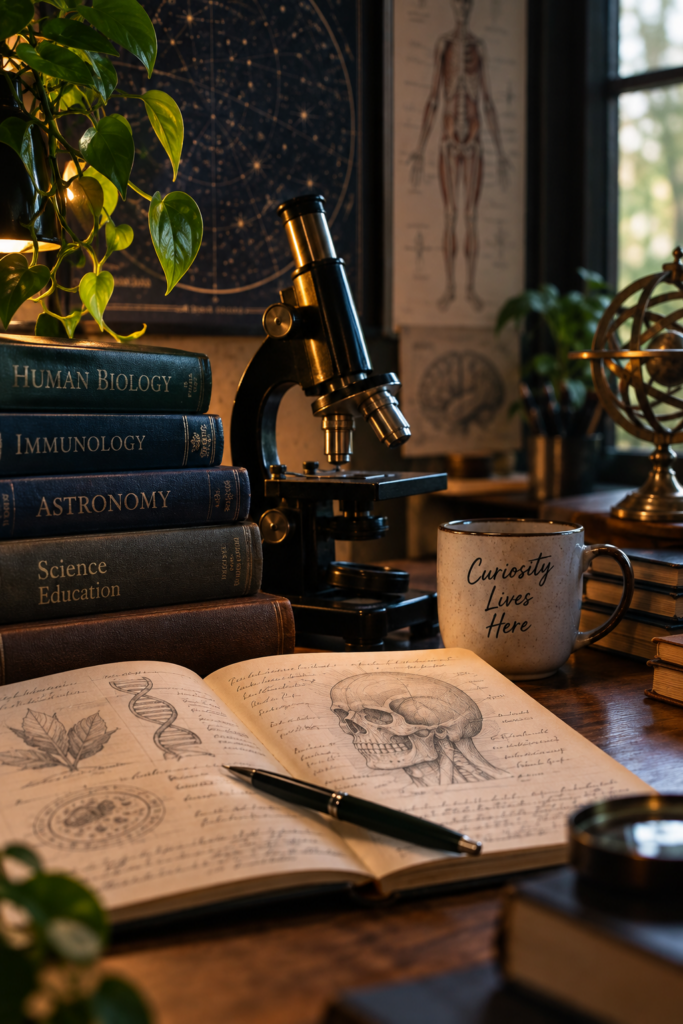
My academic path took me deep into science, earning degrees in Human Biology, Immunology, and Science Teaching. But what fascinated me wasn’t memorizing facts or formulas. It was figuring out why things happen—and finding the connections that make something complicated suddenly make sense.
I spent fifteen years teaching science, from Biology and Anatomy to Astronomy. The subject changed, but the challenge didn’t: take something complex, find the story inside it, and make it understandable.
That instinct eventually took me beyond my own classroom and into Teaching and Learning, working with educators across subjects and grade levels. It reinforced something I’d already learned: people connect with ideas when they’re given context, structure, and meaning.
Turns out, that’s useful when you’re handed complicated characters, too.
Where Language Comes Alive
Long before I stepped behind a microphone, I was fascinated by what happens when words are spoken.
Long before I understood narration as a craft, I was fascinated by what happens when words are given a voice. In high school, I gravitated toward writing, speech, and drama, drawn to the way meaning shifts when language is performed. I loved readers’ theater and choral reading, where pacing, emphasis, and voice could transform words on a page into something communal and alive.
But my deepest relationship with books was always more private. When I read, I disappeared into them. I could step out of my own life and into another one—another place, another time, another adventure. I could be fearless, reckless, brilliant, haunted, heroic, or wonderfully lost somewhere that existed only because a writer had imagined it and I had opened the cover. Characters weren’t simply names moving through a plot. They had personalities and voices. Some became friends. Some became enemies. Some irritated me beyond reason. Others made me laugh… and cry. Always, when the book ended, I missed them.
That love of stories stayed with me even as my professional life took me into science and education. I became a teacher because I wanted to spark curiosity—to help kids look at the world and wonder why? But I also recognized the kids who loved stories the way I did: the readers who always had a book nearby, the writers filling notebooks with worlds of their own. I loved talking books with them, recommending the next adventure, and encouraging whatever strange and wonderful thing they were creating. I loved encouraging that part of them because I understood exactly what it meant to find somewhere you belonged inside a book.
I carried that into my own family, too. I read to my children from the moment they were born. Stories were something we shared long before they could understand the words themselves. Not because reading was something they needed to learn, but because books were something I wanted them to love. As they grew, I got to watch them discover their own books, their own characters, their own worlds—and experience the peculiar joy of loving a story together.
It wasn’t until much later that I realized something that genuinely surprised me:
not everyone experiences books the way I do.
For many people, there isn’t a voice narrating inside their head when they read. Characters don’t necessarily arrive with voices of their own. The room doesn’t always materialize around them; the scene doesn’t automatically start playing somewhere behind their eyes. Something I had taken for granted my entire life—the ability to fall through a page and be there—wasn’t universal.
And that realization changed the way I thought about narration.
Because I know how much joy I’ve gotten from these other worlds. I’ve traveled places that don’t exist, lived lives that aren’t mine, loved characters who aren’t real, rooted for people I probably shouldn’t have, and developed grudges against fictional people who absolutely deserved them.
I want to share that.
I want someone listening to hear more than words being read aloud. I want them to meet the characters. Feel the tension. Catch the humor. See the room. Get angry, get scared, laugh at the wrong moment, and become far too emotionally invested in people who technically don’t exist.
That’s what I love about narration: I get to use my voice to open the door
and invite someone else into the story.
Giving Stories a Voice
Everything I’ve lived, learned, taught, read, and imagined comes with me to the microphone.
Narration brings together parts of me that once seemed completely separate: the kid who disappeared into books, the scientist who always wants to know why, the teacher who learned how to make complicated things clear, and the lifelong reader who hears characters long before she ever speaks them aloud.
That combination shapes the way I approach a story. I want to understand what makes a character tick—not just what she says, but what she means, what she’s hiding, what she wants, and what she absolutely does not want anyone else to know. I’m drawn to the contradictions, the tension underneath the dialogue, the humor tucked into uncomfortable places, and all the little human details that make someone on a page feel real.
I don’t want my voice to sit on top of a story. I want it to disappear inside it. The performance should belong to the world the author created—to its characters, its rhythm, its atmosphere, and its emotional truth.
Because the best part, for me, is still the same thing I’ve loved about books all my life: getting completely lost in another world.
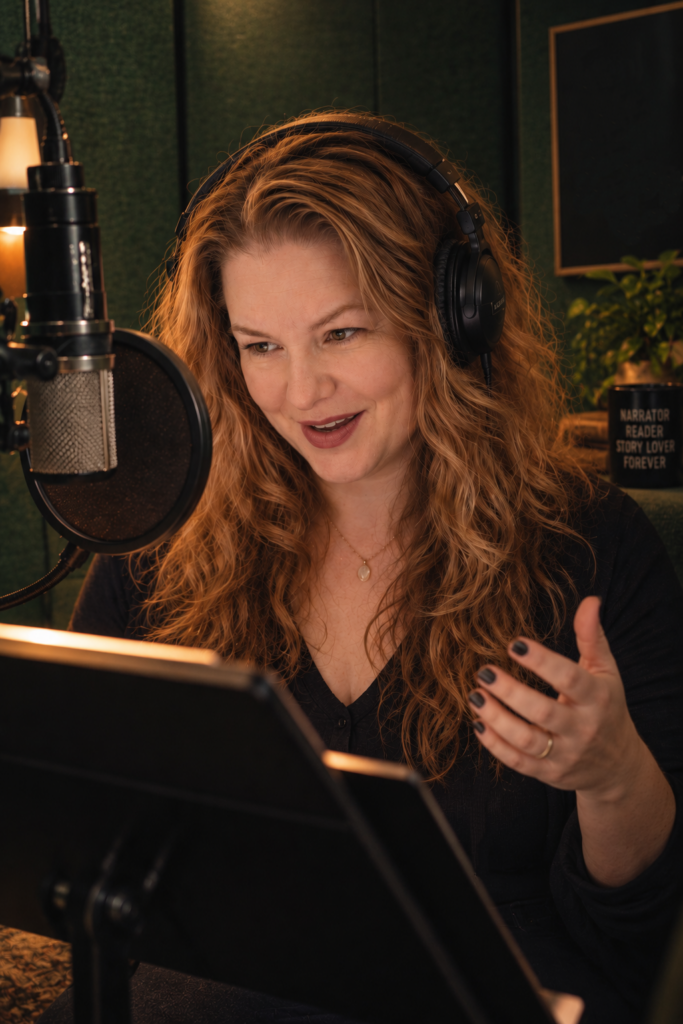
Now I get to take listeners with me.
Stories are how we cross into worlds that do not belong to us—and stay long enough to understand them.